Moving to Boston: A 2026 Relocation Guide
Where to live, what it costs, the famous September 1st rush, parking permits, and getting around — practical advice from a Boston moving company that's relocated 43,126+ households since 2002.
Boston is one of the most rewarding — and most logistically tricky — cities to move to in the country. It's walkable, historic, and packed with distinct neighborhoods, but it also has narrow colonial streets, plenty of stair-only walk-ups, a permit system for parking a moving truck, and a once-a-year moving frenzy on September 1st. This guide covers what you actually need to know to land smoothly, from picking a neighborhood to booking the right movers.
Boston Neighborhoods at a Glance
A quick orientation to where people live in and around the city — each neighborhood has its own character, price point, and moving quirks.
Back Bay
Elegant Victorian brownstones, Newbury Street shopping, and central, highly walkable streets — among the city's most sought-after (and priciest) addresses.
Beacon Hill
Gas-lit, cobblestoned, and historic, right beside Boston Common. Charming Federal-style row houses with famously tight street access for moving trucks.
South End
The largest Victorian row-house district in the country, known for a celebrated restaurant scene and tree-lined streets popular with professionals.
North End
Boston's historic Italian neighborhood — narrow colonial streets, walk-up apartments, and some of the best food in the city.
Seaport / South Boston
Modern waterfront high-rises in the Seaport and a mix of classic and new in Southie — a magnet for younger professionals.
Fenway / Kenmore
Next to the universities, the Longwood medical area, and Fenway Park — energetic and student-heavy, with lots of rentals.
Jamaica Plain
Leafy and diverse, wrapped around Jamaica Pond and the Emerald Necklace. A favorite with families and young professionals seeking more green space.
Cambridge
Across the Charles River — home to Harvard and MIT, with lively Harvard, Central, and Kendall squares and quick access into the city.
Somerville
Dense, creative, and social around Davis and Union squares, now better connected than ever via the Green Line Extension.
Brighton / Allston
Student-heavy and relatively affordable, with the largest concentration of September 1st lease turnovers in the city.
Dorchester
Boston's largest and most diverse neighborhood — classic triple-deckers and more space for your money, with strong Red Line access.
Brookline & Quincy
Just outside Boston proper: Brookline for leafy, family-friendly streets and strong schools; Quincy for more affordable living on the Red Line.
Moving within a specific community? See all 290+ cities and neighborhoods we serve.
The September 1st Rush
If there's one thing every newcomer should understand about Boston, it's September 1st. A huge share of the city's leases — driven by its enormous student population — all turn over on the same day. The result is the single busiest moving day in Boston: streets jam with double-parked trucks, U-Hauls are booked solid, discarded furniture lines the sidewalks (locals call it “Allston Christmas”), and professional movers sell out weeks in advance.
If your start date is flexible, moving even a few days before or after September 1st makes for a dramatically smoother day. If it isn't, the move is the time to plan early: lock in your movers and reserve your street permit as far ahead as you can. The same logic applies, to a lesser degree, to June 1st and the end of any month.
Getting Around (and Parking)
Boston is genuinely walkable, and the MBTA — “the T” — covers the city and suburbs by subway, bus, and commuter rail. Many residents in the central neighborhoods live car-free, because parking is scarce and street-cleaning rules are strict. If you do bring a car, budget for a resident parking sticker and, in some neighborhoods, a rented spot.
That same parking scarcity is exactly why moving day needs planning. A moving truck can't simply pull up and idle — on most streets it needs a reserved space. That's where a street-occupancy permit comes in.
Planning Your Move to Boston
Four things that make the difference between a chaotic move-in and a smooth one.
Time your move around September 1st
An enormous share of Boston leases turn over on September 1st, driven by the student population. That single day is the busiest moving day in the city — streets clog, trucks are scarce, and good movers book out weeks ahead. If you can avoid moving on or right around September 1st, you'll have an easier (and often cheaper) day. If you can't, book your movers as early as possible.
Reserve a moving (street-occupancy) permit
On most Boston streets, a moving truck needs a street-occupancy permit to legally hold curb space out front — otherwise you risk no parking near your door and a long carry. Permits are issued by the City of Boston and should be requested in advance. Our team can walk you through exactly what your address needs.
Sort out building requirements early
Condos and high-rises typically require a certificate of insurance (COI) naming the building, a reserved freight-elevator window, and approved move hours. Handle this with your building or property manager before move day — or let us coordinate it for you so your crew isn't stuck waiting in the lobby.
Hire a licensed, local mover
Boston's narrow streets, walk-ups, and permit rules reward movers who actually know the city. Verify your mover's license and insurance, confirm transparent hourly pricing with no stair or fuel fees, and read recent reviews. Our guide to choosing a Boston mover walks through exactly what to check.
Moving to Boston — FAQ
When do most leases start in Boston?
What's the best Boston neighborhood for newcomers?
Do I need a moving permit to move to Boston?
How much does it cost to move to Boston?
Do I need a car in Boston?
How far in advance should I book movers in Boston?
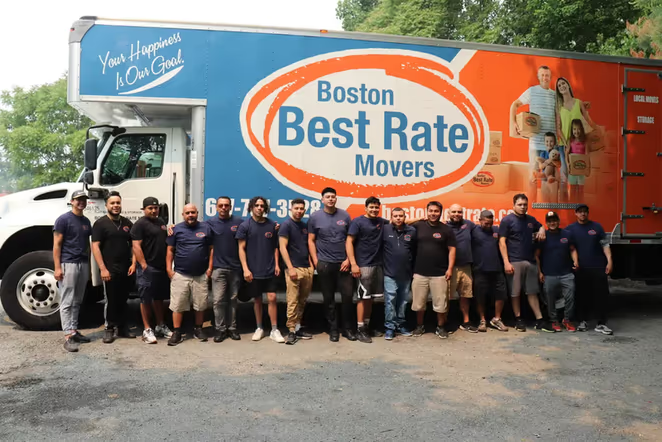
Make Boston Your Home — the Easy Way
Local move or long-distance into Boston, we handle the permits, the buildings, and the heavy lifting. Licensed, insured, 1,244+ reviews, no hidden fees.