The short answer
Truck sizes for Boston's narrow streets: what each size holds, the Storrow Drive problem, and why smaller-truck-more-trips often wins.
In most of America, you pick a moving truck by how much stuff you have. In Boston, you pick it by whether it fits down the street. The North End's colonial lanes, Beacon Hill's grades, Southie's double-parked one-ways, and half the city's low rail bridges (Storrow Drive eats box trucks every September 1st — really) make truck sizing a two-variable problem: volume and access. This guide covers the real capacity of each truck size, how Boston streets change the math, what we drive and why, and the sizing guide if you're renting for a DIY move.
Truck Sizes and What They Actually Hold
- 10–12 ft box: a studio or dorm — roughly 25–35 boxes plus a bed, dresser, and small sofa. The footprint of a large van; fits almost anywhere a car fits.
- 15–17 ft: the 1-bedroom workhorse — a full apartment's furniture plus 40–60 boxes. Still maneuverable on most Boston streets with a competent driver.
- 20–22 ft: 2–3 bedrooms — the size where loading skill starts to matter as much as cubic feet, and where narrow streets start to bite.
- 26 ft: 3–4+ bedrooms, the largest non-CDL truck. On a suburban cul-de-sac, perfect; on Salem Street in the North End, a geometry lesson you will lose.
Real-world note: listed cubic feet assume professional loading — floor-to-ceiling tiers, strapped walls. Amateur loading typically uses 60–70% of capacity, which is how DIY 2-bedroom moves end up making a second trip in a "big enough" truck.
The Boston Variables
- Street width: parts of the North End, Beacon Hill, and Charlestown were laid out for carts. A 26-footer may physically enter and then be unable to turn, while a 16-footer parks at the door. Smaller-truck-more-trips beats bigger-truck-parked-three-blocks-away on an hourly clock more often than people expect.
- Bridge clearances: Storrow Drive and Memorial Drive are car-only parkways with ~10 ft clearances — box trucks are forbidden, GPS routes them there anyway, and the result makes the news every September. Professional drivers route around them on instinct; DIY renters must plan truck-legal routes deliberately.
- The parking equation: whatever the size, the truck needs a legal place to stand for hours — which is the moving permit, sized to your truck (a 40-foot reservation fits a 26-ft truck plus ramp; tell the city the right length).
- Building rules: some complexes and Seaport towers restrict truck sizes at the dock, and some alleys are fire lanes where even permitted trucks can't stand. The building manager knows — ask before, not during.
What We Drive, and How We Choose
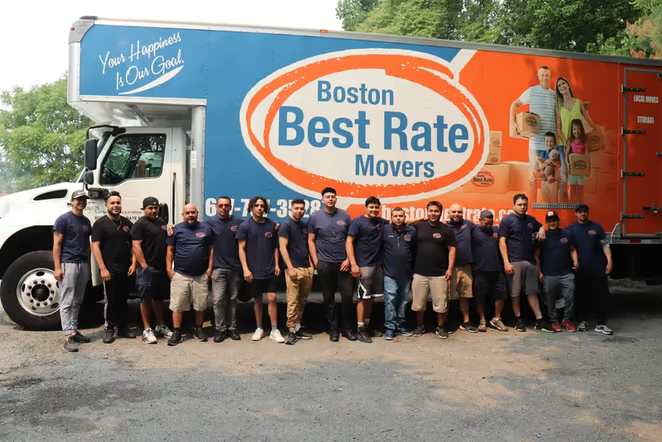
Our fleet is built around Boston's geometry — trucks sized to thread the city while still swallowing full households, loaded by crews who pack them like Tetris finals. When you book, we choose the truck (or trucks — two mid-size beats one giant on certain streets) based on your inventory and both addresses; it's part of the quote, not your homework. The truck, like the padding, dollies, and wrap, is included in the hourly rate — no separate truck fee, none of the add-ons that pad rental-style pricing.
Renting for DIY? The Honest Sizing Guide
If you're going the rental route (the full cost comparison is in movers vs. DIY), size up from the rental company's optimistic chart: their "1–2 rooms" truck assumes professional density. Practical guidance — studio: 10–12 ft; 1BR: 15 ft; 2BR: 17–20 ft; 3BR: 22–26 ft or two trips. Then the Boston add-ons: book weeks ahead for month-end dates (rental fleets sell out like movers do), plan a truck-legal route that avoids the parkways, budget the permit for the curb, and practice the mirrors before Atlantic Ave — a box truck drives like a building in wind.
Apartment Movers: Match the Truck to the Move Pattern
Boston apartment moves have a shape: small-ish loads, hard access, hourly economics. That's why the right answer is often the mid-size truck with a 3-person crew — the truck parks close (permit!), the crew shuttles efficiently, and the clock stays short. The wrong answer is the giant truck "to be safe" that can't park within 200 feet: on hourly billing, carry distance is the most expensive distance there is. For walk-up specifics, the walk-up playbook pairs with this guide.
Truck Size FAQ
What size truck for a 2-bedroom Boston apartment?
Professionally loaded: 17–20 ft. DIY loaded: 20–22 ft or plan a second trip. Either way, reserve the curb space to match.
Can a 26-foot truck get into the North End or Beacon Hill?
Onto some streets, technically; useful at your door, rarely. These neighborhoods are where two smaller trucks or a shuttle approach wins — a judgment call we make in the quote, free.
Why do trucks hit the Storrow Drive bridges every year?
GPS defaults + car-only parkway + 10-foot clearances + September 1st rental drivers. If you rent: set your navigation to truck mode, and when in doubt, take the streets, not the parkways.
Does truck size change the price?
With us, no — the truck is included in the hourly rate, and we send what the job needs. With rentals, bigger costs more per day plus proportionally more fuel.
Skip the geometry homework: tell us what you're moving and where, and the right truck shows up with the right crew — free written quote. 33,000+ Boston moves, zero Storrow incidents.
Find our moving guides faster on Google
Add Boston Best Rate Movers as a preferred source and Google shows our answers first when you search — including in AI Mode.

Boston Best Rate Movers
The Boston Best Rate Movers team shares moving tips, Boston neighborhood guides, and cost-saving strategies drawn from 24+ years and 43,126+ completed moves across Greater Boston.
See All Posts.avif)